AI search is no longer an experiment. Tools like ChatGPT, Perplexity and Google Gemini increasingly shape how buyers research vendors, compare tools, and define categories.
For marketing teams with an established web presence, the challenge is not “Should we care about AI search?” It’s “How do we operationalize it without disrupting everything else?”
This 90-day roadmap shows how to systematically measure, optimize, and expand your visibility in AI-generated answers.
Month 1: Establish Your AI Visibility Baseline
Before changing content or launching new initiatives, you need clarity. AI visibility is measurable but only if you define the right inputs.
Step 1: Define Your Topic Universe
Start with the strategic layer.
Identify 5–10 core topics that define your category. These should reflect how buyers think about your space, not just how you describe your product.
Examples:
Category-level terms (“marketing automation platforms”)
Use-case terms (“reduce churn in SaaS”)
Comparison intent (“best tools for ecommerce retention”)
Problem-driven queries (“how to improve onboarding conversion”)
Each topic should represent a meaningful commercial area for your business.
For each topic, track at least 5 prompts. The total number depends on how broad your market is. A focused B2B SaaS company might track 30–50 prompts in total. A broader ecommerce or technology category may require 100+.
The goal is coverage across:
Commercial queries
Comparison queries
Problem-based queries
Educational queries
This becomes your AI “surface area.”
Tools like GetMentioned can suggest representative prompts per topic and monitor them automatically, ensuring consistency and coverage without manual setup.
Step 2: Measure Visibility, Source Dominance, and Traffic
Once topics and prompts are defined, measurement begins.
There are three core KPIs every marketing team should track.
Visibility Rate
The percentage of tracked prompts where your brand appears in AI answers.
If you monitor 40 prompts and appear in 10, your visibility rate is 25%. This becomes your baseline benchmark.
Source Dominance
How often your own domain (or owned content) is cited as a source in AI-generated answers.
AI systems frequently reference authoritative domains. If they consistently pull from your blog, reports, or landing pages, you are shaping the narrative. If competitors or third-party sites dominate citations, you are not.
This metric is particularly powerful because it reveals whether AI understands you as a primary authority — or merely as a brand mentioned elsewhere.
LLM Referral Traffic
Visibility is influence. Traffic is proof.
In Google Analytics 4, you can isolate referral traffic from AI tools by:
Filtering by referral domains (e.g., chat.openai.com, perplexity.ai)
Creating custom channel groupings for AI sources
Monitoring landing pages receiving AI traffic
You should measure:
Sessions
Engagement rate
Conversions
Assisted conversions
AI traffic often arrives with higher intent, since the user has already received a synthesized answer.
Step 3: Conduct an AI Visibility Audit (Including Competitors
With baseline metrics in place, audit what is actually happening inside AI answers.
Review:
Which prompts include you
Which ones exclude you
Which competitors appear consistently
What sources are cited
If a competitor appears in prompts where you do not, ask:
Are they cited from their own website?
Are they mentioned in high-authority third-party content?
Is their positioning clearer or more explicit?
Do they dominate a specific subtopic?
Often, the difference is not company size but clarity. AI systems reward structured, explicit, and well-positioned content.
This audit should produce a prioritized list of:
Missing commercial prompts
Underrepresented use cases
Content gaps
Authority gaps (lack of external mentions)
This list defines your next 60 days.
Month 2: Optimize What Already Exists
The biggest AI visibility gains rarely come from publishing 30 new blog posts. They come from upgrading high-impact pages.
Step 4: Strengthen Content Structure and Clarity
AI systems extract structured, direct answers.
Pages that tend to be cited frequently:
Define the topic early and clearly.
Answer the core question immediately.
Use descriptive subheadings.
Provide comparison sections where relevant.
Avoid vague positioning language.
For example, if a page targets “best tools for X,” it should explicitly state what qualifies a tool for that category and who it is for.
Based on observed AI answer patterns , content that is concise, structured, and explicit performs better in generative environments.
Rewrite priority pages with:
Clear definitions
Strong summaries
Comparison tables (when appropriate)
Clear positioning statements
This is not about writing more. It’s about writing more clearly.
Step 5: Build Topical Authority Through Clusters
AI models infer authority contextually. A single article rarely signals expertise.
Instead:
Create supporting content around your core topics.
Link between related articles.
Cover adjacent questions thoroughly.
If you want visibility in prompts about “customer retention,” you should have:
A retention strategy guide
A churn metrics breakdown
Onboarding best practices
Lifecycle optimization frameworks
This mirrors modern SEO clustering, but in AI search the contextual signals are even more important.
You are not optimizing for keywords. You are optimizing for conceptual coverage.
Step 6: Fix Technical Foundations
Technical SEO remains critical.
Based on patterns in AI-cited content, ensure:
Pages are crawlable and indexable.
Important content is not hidden behind heavy client-side rendering.
Page speed is acceptable.
Structured data (schema) is implemented where relevant.
That major AI crawlers are not unnecessarily blocked in your robots.txt.
AI systems rely heavily on content already accessible to search engines. Weak technical foundations limit visibility before content quality even matters.
Month 3: Expand Authority and Close Gaps
Once your foundation is strengthened, focus on expansion.
Step 7: Close High-Value Prompt Gaps
Identify prompts where:
Competitors appear consistently.
You have relevant expertise.
Commercial intent is strong.
Create or upgrade content specifically aligned with those intents. Not by copying competitor structure — but by providing clearer, more authoritative coverage.
Step 8: Increase Third-Party Presence
AI systems frequently cite:
Industry publications
Comparison roundups
Reports
Aggregated “best of” lists
Develop a focused outreach plan:
Contribute expert commentary.
Participate in industry roundups.
Secure inclusion in relevant comparison articles.
Publish original research that others reference.
This strengthens source dominance beyond your own domain.
Step 9: Review, Benchmark, and Institutionalize
At the end of 90 days:
Compare visibility rate to your baseline.
Measure changes in source dominance.
Evaluate growth in AI referral traffic.
Reassess competitor positioning.
AI visibility should become a recurring reporting line, not a one-off experiment.
Integrate it into:
Quarterly content planning
SEO reporting
Brand strategy discussions
This is where AI search becomes operational, not reactive.
Summary
Marketing teams that treat AI visibility as measurable, and improve it deliberately, will shape how their category is described before buyers ever visit a website.
To make implementation easier, we’ve created a downloadable 90-Day AI Search Checklist that translates this roadmap into a tactical, team-ready task list. It mirrors the phases outlined above and can be used as a working document inside your marketing team.
Free resources
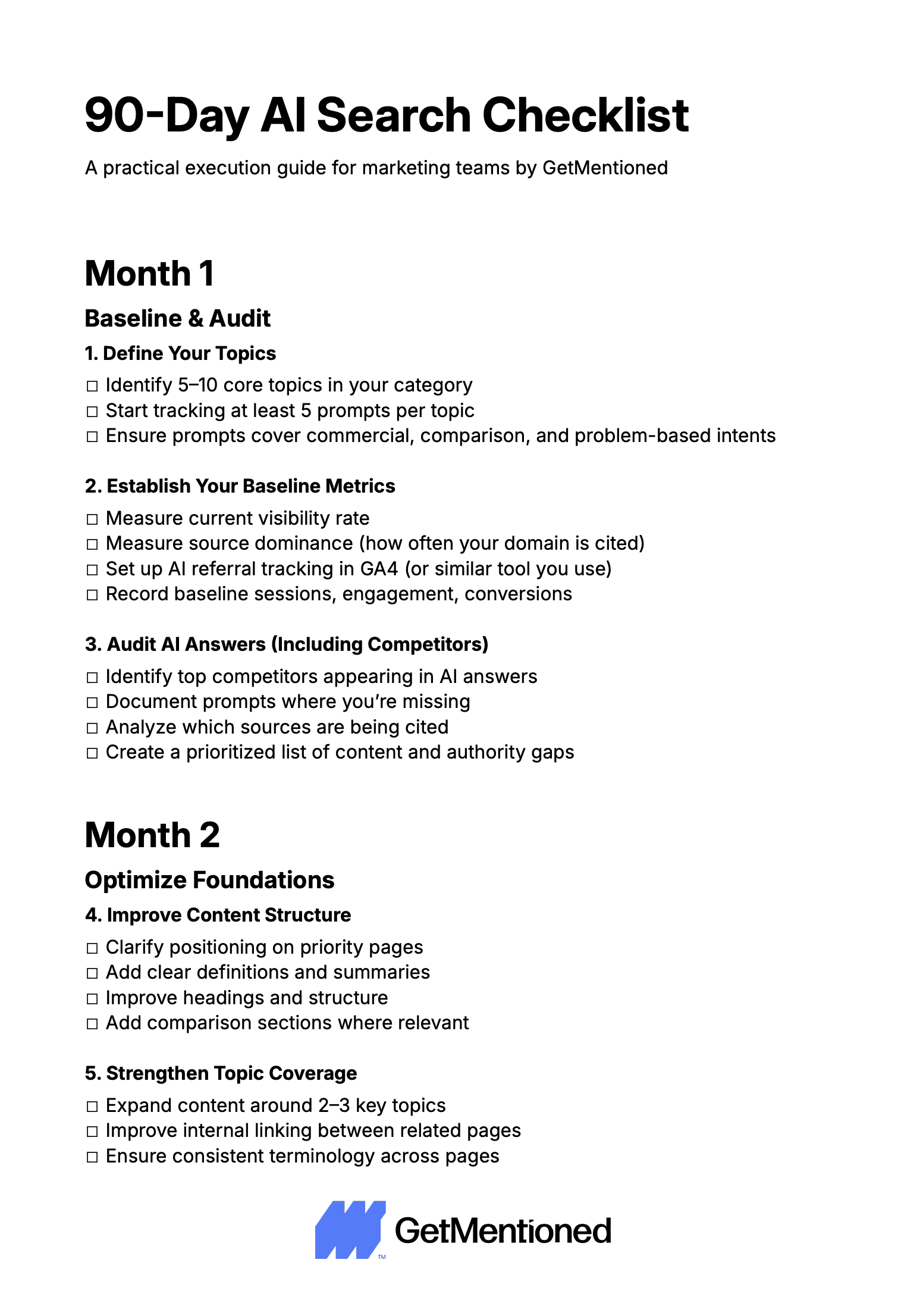
90 Day AI Search Checklist
7-day free trial
Setup in 5 minutes
No credit card required